Pages

May 30, 2018

The 7 Best Free Online Flowchart Makers

Flowcharts may not be what one thinks of as a good time, but there’s no denying that they’re incredibly useful. In fact, we’ve previously outlined creative ways to use flowcharts to streamline your life and work, in case you need ideas.
While there are great flowchart makers for Windows and other platforms, sometimes an online, web-based solution is best. That’s because these don’t need a specific hardware configuration or operating system to work—all you need is a web browser.
Here are some of the best online flowchart makers that you can use for free or at an affordable price.


1. Lucidchart
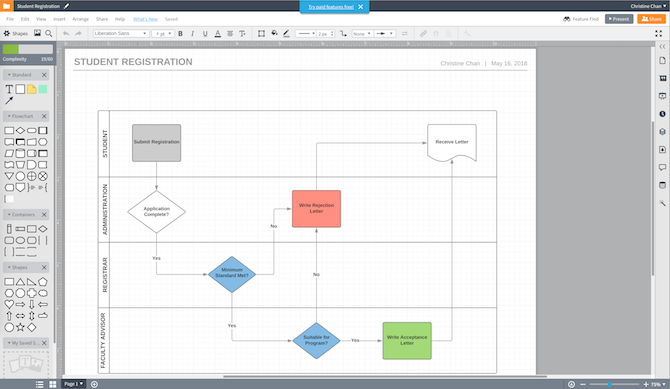
best free online flowchart makers


When it comes to these diagrams, Lucidchart is one of the best and most reliable online flowchart makers available.
The fast and fluid drag and drop interface makes it easy to create and manage flowcharts. There are pre-made templates to choose from, or you can start with a fresh blank canvas. Even free accounts get access to basic shapes, arrows, and text boxes. That is enough to get started.
Collaboration is also available for the free tier. But there are some limitations. For example, a Team user can collaborate with a Free user, but the Free user can only edit if it has 60 or fewer objects and if there aren’t any paid-level objects in it.
You can save Lucidchart documents in multiple formats. Lucidchart supports JPEG, PDF, PNG, SVG, and Visio (VDX) formats. There’s even support for importing from Amazon Web Service (AWS), Visio (VSDX), Omnigraffle, and more. And if you need to finish a flowchart later, all of your data gets stored in their cloud, so you just pick up where you left off.
Lucidchart has a free basic account tier, as well as paid plans starting at $5.95 per month for Home, $8.95 for Pro, and $20 for Team. The paid options provide more features such as more storage, unlimited shapes and documents, data linking, Microsoft Visio import, and more. If you stick with a free account, you get 25MB of storage and up to five documents.
Lucidchart is an excellent option to consider if you are looking for an alternative flowchart creator to Visio. It’s accessible from any device with a web browser, has a streamlined and intuitive design, and is affordable.
Lucidchart Is the Visio Alternative You've Been Waiting For Lucidchart Is the Visio Alternative You've Been Waiting For You might not have heard of Lucidchart before, but I bet you've heard of Microsoft Visio. Read More


2. draw.io
best free online flowchart makers


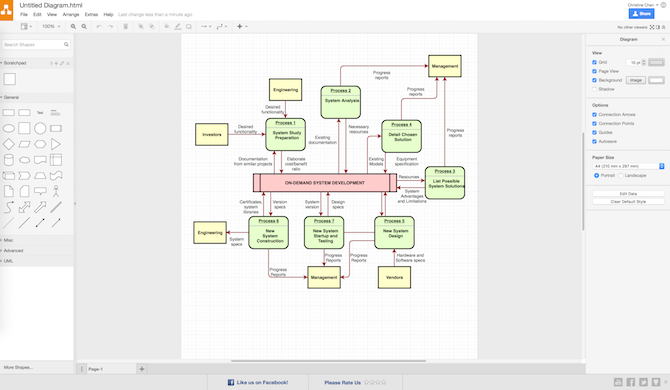
daw.io fits the bill for anyone looking for a completely free flowchart solution.
There’s no account to sign up for with draw.io. All you need to do to get started is choose your storage space, which gets remembered for later. Options include Google Drive, Dropbox, OneDrive, and local storage. If you need collaboration with others, Google Drive is the best choice since draw.io leverages Google Drive’s collaboration features.
Once you pick your storage space option, you can then make a new flowchart diagram from scratch, or use a template from the ones provided. There are only five flowchart templates to pick from (while Lucidchart has over 10 templates). There are other non-flowchart diagram templates if you need them.
If draw.io has the kind of flowchart you need, then go for it. You can add shapes, arrows, and other objects from the side menu just by dropping it in. Everything’s fairly straightforward with draw.io, though it’s not as intuitive or streamlined as Lucidchart.
draw.io supports file imports, and you can import from JPEG, PNG, SVG, Gliffy, Lucidchart, and VSDX. Diagrams you create with draw.io get saved or exported as HTML, JPEG, PDF, PNG, SVG, and XML.
Unlike a lot of the other options, draw.io is completely free with no option for paid accounts. It has a somewhat limited feature set and isn’t as good as other tools, but you can’t beat the price of free.


3. Cacoo
best free online flowchart makers


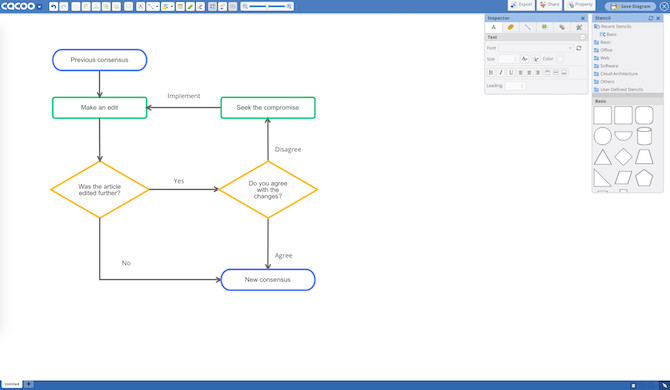
If real-time collaboration is a requirement for your online flowchart maker, then Cacoo has the others beat.
Much like Lucidchart, Cacoo comes with a super streamlined and fluid interface that’s pleasant on the eyes. Cacoo comes with a multitude of templates for your project, whether it’s flowcharts, wireframes, Venn diagrams, and a rich variety of other diagrams. For flowcharts, Cacoo has an extensive range of shapes to choose from, no matter the type of project. And everything’s done through simple drag-and-drop.
The best feature of Cacoo is the real-time collaboration. Multiple people on your team can work on the flowchart at once. Also, there’s a chat feature so you can see and comment on changes as they happen. And since things can get a bit complicated with multiple people working on one document at the same time, Cacoo provides memo fields so you can keep track of who’s involved.
Cacoo seems built with teams in mind, which you clearly see with their project folders and security settings for members. Cacoo’s still great for single users, as you get storage for 1000 sheets, unlimited sharing, SVG import and export, and more.
The pricing for Cacoo is reasonable enough. Single users can get a plan starting at $4.95 per month, and then there’s the Team level starting at $18 per month for three users (and they go up from there). The Enterprise level allows you to install Cacoo on your own private server, and that starts at $600 a year for 10 users. All account levels come with a 14-day free trial.


4. Gliffy
best free online flowchart makers


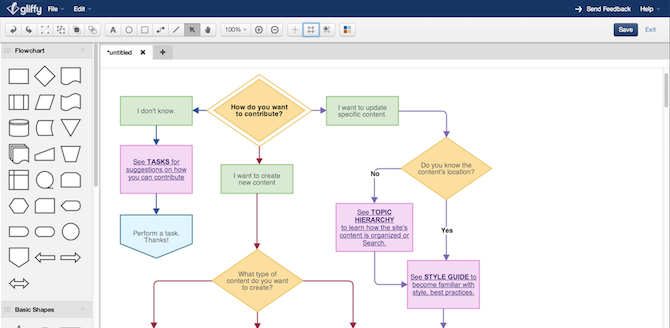
In the moments when you just need a simple and lightweight tool for the job, consider Gliffy.
Compared to the other services, Gliffy is a bit more barebones. It’s a good option when you need to flowchart an idea quickly and easily.
You can create any flowchart in just a few clicks. There are basic templates available that make it even easier to reach your final product. However, when you start to get down and fine-tune your flowcharts, the editing process is not as smooth as others, like Lucidchart. There are a few quirks that may slow you down a bit, but snap-on grids and other alignment tools are nice to have.
As an HTML5 cloud app, it can work offline too. And when you need to collaborate, Gliffy provides ways to share and even invite others to view, edit, or leave comments, but the collaboration isn’t as powerful as other flowcharting tools.
Gliffy offers plans starting at $7.99 per month for single users, and a team plan for $4.99 per month, both billed annually. For enterprise users, it includes everything in the team plan, but with even more security and features.


5. Wireflow
best free online flowchart makers


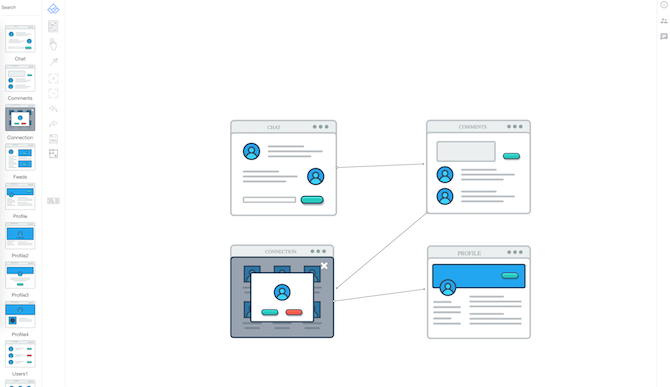
Another completely free option for your consideration is Wireflow. It is the perfect tool for web developers and app designers.
Wireflow is a beautiful flowchart tool for designing user flows and wireframes. A pretty and intuitive interface offers a variety of different chart designs, that you can drag-and-drop onto a fresh canvas. There are many connectors to choose from, and everything’s manageable through drag-and-drop.
When you’re done creating your diagram, you can export the final product as a JPG. This is the biggest drawback of Wireflow, as you’re unable to pick a different format. Again, it’s free to use with no options for paid plans, so that’s expected. There’s also quite a lot of scrolling involved since there are so many different chart types to go through.
If all you need are to create flowcharts to demonstrate user flows for software, then Wireflow gets the job done.


6. Textographo
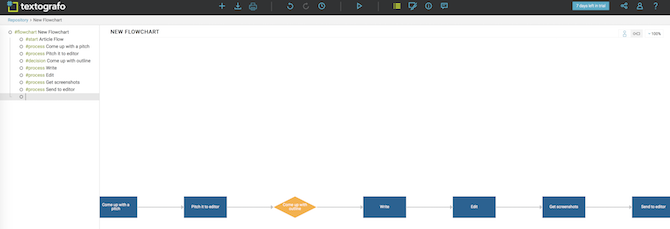
best free online flowchart makers


Need to create flowcharts but don’t want to deal with the finicky positioning of shape objects and arrows? Then Textographo is for you.
Textographo is a unique flowchart tool that uses text. All the user needs to do is type out their chart in a specific text syntax that uses hashtags, keywords, and some markup. Textographo takes this text and turns it into static and animated diagrams that include flowcharts, mindmaps, organizational charts, decision trees, and much more.
Once you’ve got the text laid out, Textographo automatically gets to work and organizes everything into diagram form. It’s super easy, intuitive, and streamlined. Users may also customize it by choosing a theme they like or changing the layout to something else that better suits their needs.
Since Textographo saves all documents in their cloud, you’re able to collaborate with your team by inviting them to view, give feedback, and share ideas.
There are two account levels for Textographo: Essentials and Premium. Essentials starts at $8 per month if billed annually, or $12 per month. Premium costs $14 per month annually, or $19 per month. Considering the distinctive and convenient system Textographo uses, the cost is fairly reasonable.


7. Google Drawings
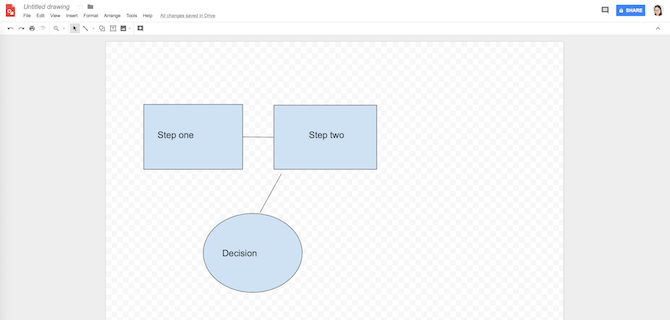
best free online flowchart makers


If you’re already using a Google account, then there’s a free option that’s already been available to you: Google Drawings.
In order to access Google Drawings, you’ll first need to get to your Google Drive. Then just click Create New and choose Google Drawings under the More option.
Use the extensive shapes in Google Drawings. Add basic shapes, arrows, callouts, and even equation symbols to your blank canvas. You move everything around through simple drag-and-drop, and you can resize and rotate as needed.
And since Google Drawings is through Google Drive, sharing and collaborating is no problem. Just invite others through email, and give them permissions to view, edit, or comment. You’re able to export your flowchart as an image file or SVG, or you could even publish it to the web.
Google Drawings is free to use since it’s through your Google account, where you get 15GB of free storage across all Google apps. The storage space can get upgraded to 100GB, 1TB, or 10TB for $1.99, $9.99, or $99.99 per month, respectively.

The Best Solution for Visual Brainstorming

Flowcharts are an incredibly powerful tool. They lay out complex processes into a much more simple and easy to understand manner, and complicated projects don’t seem so scary anymore.
We’ve just discussed the best options for online-only flowchart services—some are completely free, and others offer just free trials of their premium plans. But like everything in life, you get what you pay for. That’s why we prefer Lucidchart when making flowcharts online.

Source: https://www.makeuseof.com/tag/free-online-flowchart-makers/

4 Anonymous Web Browsers That Are Completely Private

Private information is big business. It should come as no surprise, therefore, that everyone is trying to watch you. The NSA, the UK government, Microsoft, cyber-criminals, your creepy neighbor from across the street; they all want to know what you’re doing, all the time.

Unfortunately, unless you want to take excessively drastic measures, it’s almost impossible to remove yourself from the global grid completely. But there are some steps you can take to reduce your information footprint.
One of the best places to start is with your browser. It’s your main portal to the web, so using a more secure option will make a big difference to your privacy.
Here are four anonymous web browsers that are (almost) completely private.


1. Tor Browser

Available On: Windows, Mac, Linux
The Tor network has one simple goal: anonymous communication. The network aims to protect a user’s location, browser history, personal data, and online messages from any person or bot that’s performing network traffic analysis.

How it Works

Network traffic analysis is arguably the most powerful weapon in a data collector’s armory. It can track your behavior and interests for advertising companies, it can lead to price discrimination on online shopping sites based on location, it can even reveal your identity to people who might want to silence or harm you.
Basic encryption techniques don’t protect you against traffic analysis. Data sent over the internet has two key aspects: the payload and the header. The payload is the actual data (for example, the contents of an email), the header helps the data get to its destination. It includes information such as source, size, and timestamps. Encryption can only hide the payload, not the header.
And that’s when Tor comes in. It sends your internet traffic through so many individual relays and tunnels that the header is nonsensical to traffic analysis tools. In simple terms, instead of going directly from A to B, the network sends your traffic on a mazy route through lots of locations. A sniffer looking at a single point on that route has no way to tell where the traffic originated or where it’s going.

Browser Features

To access the Tor network, you need to use the Tor Browser. It’s so secure that the US Navy uses it for intelligence gathering and by law enforcement organizations who want to visit websites without leaving government IP addresses in the site’s log.

You don’t need to install any software on your machine; the browser is a portable app that can live on a USB stick. It means you can use the service regardless of what computer you’re working on, even if it’s in a public location such as a library or university.


The browser itself will be instantly recognizable to Firefox users, but there are a couple of notable changes. The biggest difference is the integration of NoScript; it’s included by default. Unlike the regular NoScript add-on – which can be complicated to use – the Tor version has an easy-to-use slider to manage your privacy.
There are also some downsides to using the Tor Browser. For most users, the biggest issue is speed. Because your traffic is taking such a twisty route to get to its destination, your browsing experience will not be as fast. If you have a good connection, it might not be an issue, but if your internet speed is slow, Tor might become painful to use.
Ultimately, Tor doesn’t guarantee anonymity. Taking online risks – such as downloading torrents or using unscrupulous browser plugins – will still leave you vulnerable. But when compared to the mainstream browsers like Chrome and Safari, there is no contest.


Other Options

No other browser comes close to Tor in terms of privacy and anonymity, but three other options deserve your attention.
They’re ideal if Tor sounds a bit extreme, but you still don’t want to give Google et al a free reign on your personal data.


2. Epic Browser

Available On: Windows, Mac
Epic Browser doesn’t use a specialized onion network, but it does immediately disable lots of the most common ways your privacy is comprised when you’re surfing the web.
For example, it doesn’t save your history, there’s no DNS pre-fetching, it doesn’t allow third-party cookies, there are no web or DNS caches, and there’s no autofill feature.


When you close your session, the browser automatically deletes any associated databases, preferences, pepper data, and cookies from Flash and Silverlight.


3. SRWare Iron

Available On: Windows, Mac, Linux, Android
If you’re a Google Chrome user, SRWare Iron will be familiar; it’s based on the open-source Chromium project, so a lot of the on-screen visuals look very similar.
The main difference between Chrome and SRWare Iron is data protection. Experts have criticized Chrome for its reliance on a “Unique User ID”; every time you start a session, Google is alerted to your data usage.
SRWare strips out the usage of an ID along with other Chrome privacy concerns such as search suggestions.

Check the table below for a complete list of differences between the two:


4. Comodo Dragon Browser


Available On: Windows, Mac, Linux
Again, Comodo doesn’t come close to Tor Browser, but it does have some built-in tools that’ll make browsing the web a safer experience.
It’ll automatically block all tracking, cookies, and web spies, it comes with built-in domain validation technology that’ll instantly segregate strong and weak SSL certificates, and it uses the Comodo anti-virus suite to protect you from malware, viruses, and other attack vectors.

Like SRWare Iron, it’s based on Chrome, so it’ll be an easy switch for a lot of people.


Which Browser Do You Use?

There are some other privacy-orientated browsers which deserve an honorable mention such as Yandex and Dooble – but in my opinion, the four I’ve listed are the clear winners.
However, I’m sure many of you don’t agree with me. Now it’s your turn to share your favorites; which browser do you turn to when you want to stay anonymous and out-of-sight?


Source: http://www.makeuseof.com/tag/2-anonymous-web-browsers-completely-private-secure/

April 19, 2018

Google Chrome 66: password export, autoplay blocker, and security updates

Google started the rollout of Google Chrome 66 for all supported platforms today. The new version of the web browser re-introduces a functional password exporter, comes with video autoplay blocking functionality, and security fixes among other changes.
Google is pretty tight-lipped about Chrome releases and Chrome 66 does not change that at all. The official blog post on the Chrome Releases website reveals only some of the changes that went into the new browser version.

The announcement reveals the third-party reported security issues that were fixed in Chrome 66, and that a site isolation trial is run on a small subset of Chrome users.
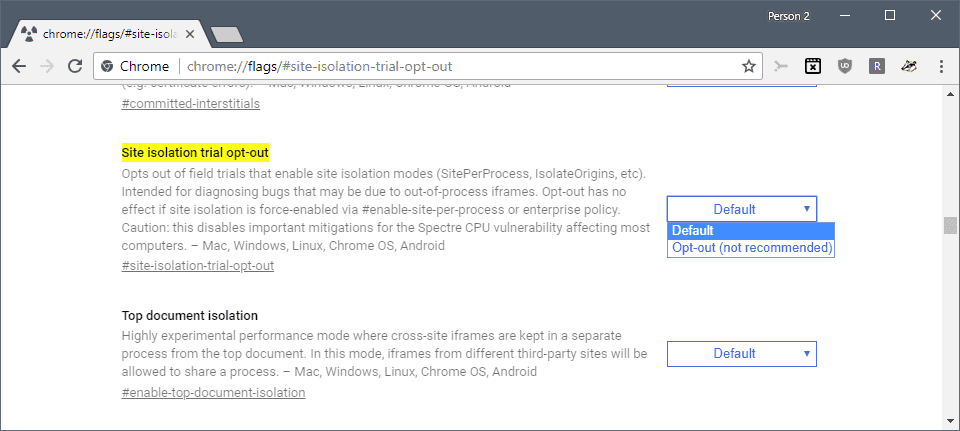
Google Chrome users who don't want to participate in the trial may load chrome://flags#site-isolation-trial-opt-out  to opt-out of the trial by selecting opt-out (not recommended) as the default status.


chrome 66 site isolation


Chrome users who are interested in the feature may visit the test site mentioned on this Chromium page to find out if Site Isolation is active in the browser.
Chrome 66 requires at least Mac OS X 10.10; Chrome 65 was the last version of the web browser that supported Mac OS X 10.9.
Google does publish a changelog for Chrome releases but it is quite long and technical, and it will take hours to go through all of it.
One of the new features in Chrome 66 is better handling of autoplaying video with sound. Basically, what Chrome does is block video on (most) sites if audio is enabled. This should take care of autoplaying video ads with sound and other autoplaying videos with sound on sites.

When Chrome encounters an autoplaying video with audio on a site, it blocks the video from playing but the browser won't interfere with autoplaying video without sound.
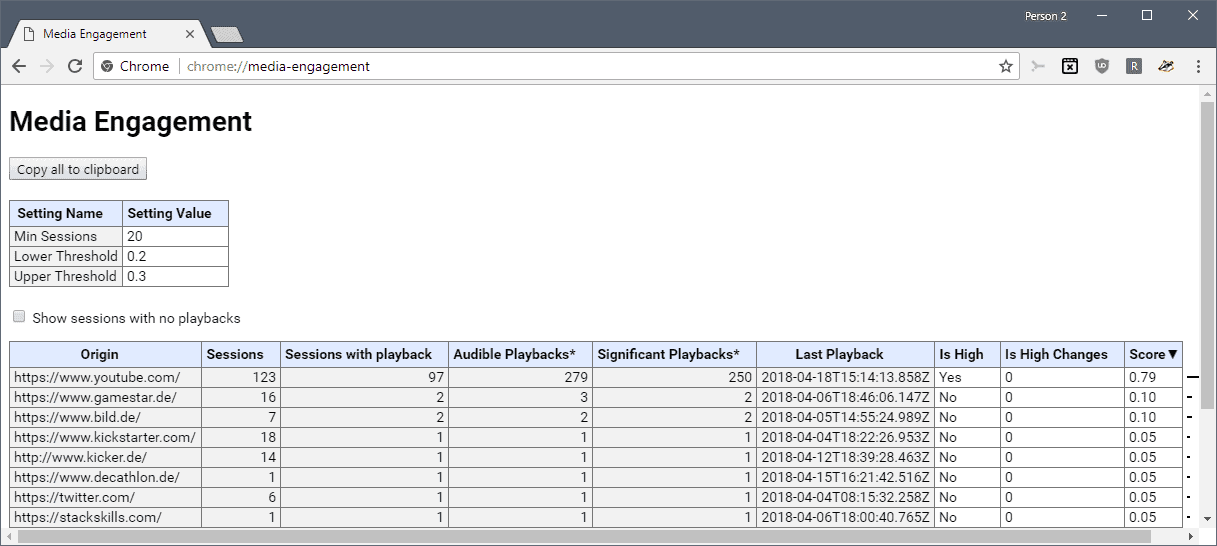
There are exceptions to the rule and the main rule that Chrome uses to determine whether to play video with sound or not is based on a site's Media Engagement Index.
Basically, if you interacted with the site or played media on it previously, video with sound may still autoplay.
Google's initial plan was to release video with sound autoplay blocking in Chrome 64, but the functionality was postponed.
You may load chrome://media-engagement/ in the Chrome browser to display the score of each site you visited.


media engagement chrome


Most users won't notice a difference on sites that play media with sound automatically if they interact with the site regularly. The change affects site new sites originally for the most part that play media with sound automatically.
Tip: check out these guides for additional information on controlling video and audio playback in Chrome:
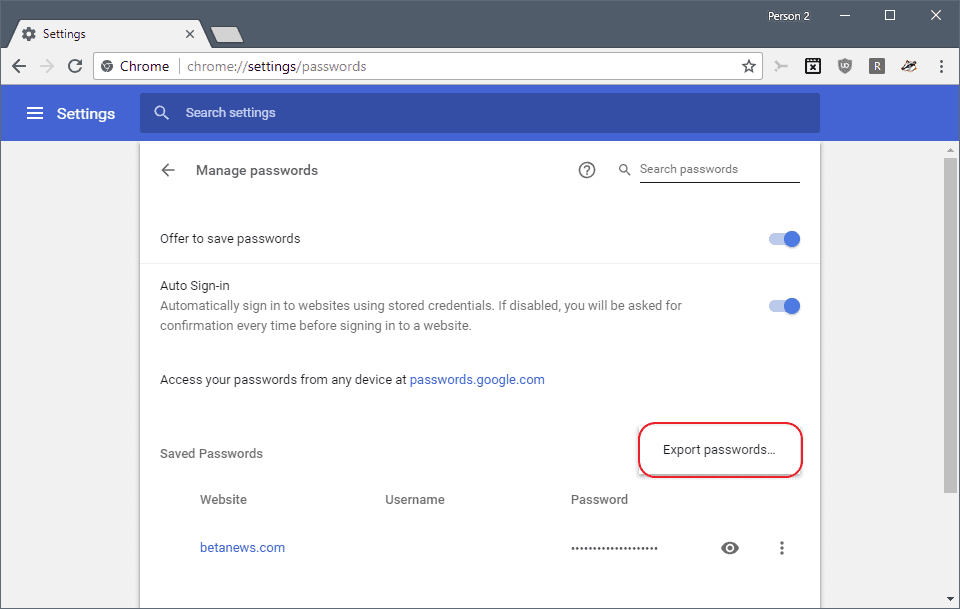
Google re-introduced the option to export passwords in Chrome 66.


chrome export passwords


Here is how you export all saved passwords in Chrome 66 or newer:
  1. Load chrome://settings/passwords.
  2. Click on the menu next to "saved passwords".
  3. Select export passwords.
  4. Select "export passwords" again when the prompt appears. Chrome warns you that saved passwords are not encrypted and thus visible to anyone with access to the exported file.
  5. You are asked to type your Windows username and password to confirm the exporting.
  6. Select a location to save the file Chrome Passwords.csv to.
Google announced that the update to Chrome 66 will roll out in the coming days and weeks. Desktop users, at least, can load chrome://settings/help to run a manual check for updates. Chrome 66 should get picked up during the check.

Source: https://www.ghacks.net/2018/04/18/google-chrome-66-password-export-autoplay-blocker-and-security-updates/

February 5, 2018

Google Chrome news - Major update will change the way you use the internet browser

Google Chrome users will be getting a major new update this month
users will be getting a big update soon that brings with it a game changing new feature.
Google Chrome is without a doubt the most popular internet browser in the world right now.
NetMarketShare stats for the whole of last year show Google Chrome as having a staggering 58.90 per cent chunk of the internet browser marketplace.
Its nearest rival, Mozilla’s FireFox, has a 13.29 per cent share while Internet Explorer is on 13 per cent.
Microsoft’s newer Edge browser, which is bundled in with Windows 10, lags behind with a 3.78 per cent market share.
These stats underline how Chrome’s crown as the world’s most popular internet browser is undisputed.
And fans of Google Chrome will be getting a highly anticipated new feature in an upcoming update.
On February 15 Google Chrome users will be able to download a new update which brings with it the long-awaited built-in ad blocking feature.

Here's how to get the most from your web browser
The upcoming Google Chrome feature won’t block every advert, but will block ones that are deemed unacceptable.
The group that decides this is known as the Coalition for Better Ads, which includes Google, Facebook, News Corp, and The Washington Post.
This includes things such as pop-up adverts, ads that expand on their own and adverts with autoplaying sound and video.
Describing the upcoming feature, Google said: “Chrome has always focused on giving you the best possible experience browsing the web.
“For example, it prevents pop-ups in new tabs based on the fact that they are annoying.
“In dialogue with the Coalition and other industry groups, we plan to have Chrome stop showing ads (including those owned or served by Google) on websites that are not compliant with the Better Ads Standards starting in early 2018.”

An introduction to Google Chrome

One set of websites that have been left fearing for their future in light of the upcoming Google Chrome ad-blocker is torrent sites.
Chrome is the world’s most popular browser, and the leading browser for many torrent websites.
The upcoming ad blocker is expected to have a big effect on torrent sites and the revenue they bring in.
The owner of one torrent site, who did not want to be named, previously told TorrentFreak that the Google Chrome ad blocker could signal the end of torrents.

Source: https://www.express.co.uk/life-style/science-technology/913679/Google-Chrome-update-new-feature-Ad-Blocker-download-release-date

January 5, 2018

What You Need to Do Because of Flaws in Computer Chips

Cade Metz and Brian X. Chen

On Wednesday, a group of security experts revealed two security flaws that affect nearly all microprocessors, the digital brains of the world’s computers. These flaws, called Meltdown and Spectre, could allow hackers to lift passwords, photos, documents and other data from smartphones, PCs and the cloud computing services that many businesses rely on.
Some of the world’s largest tech companies have been working on fixes for these problems. But the researchers who discovered the flaws said one of them, Spectre, is not completely fixable. “It is a fundamental flaw in the way processors have been built over the last decades,” said Paul Kocher, one of the researchers who discovered these flaws.
Here is a guide to what you need to know and what you should do.

Where exactly are these flaws?

Both are issues with the way computer chips are designed.
Meltdown affects most processors made by Intel, the company that supplies the chips for a majority of PCs and more than 90 percent of computer servers.
Spectre is far more difficult for hackers to exploit. But it is even more pervasive, affecting Intel chips, microprocessors from the longtime Intel rival AMD and the many chips that use designs from the British company ARM. Your smartphone most likely contains an ARM chip.

Why are they such a problem?

Both flaws provide hackers with a way of stealing data, including passwords and other sensitive information. If hackers manage to get software running on one of these chips, they can grab data from other software running on the same machine.
This is a particular issue on cloud computing services.

Why are cloud computing services so important?

Operated by companies like Amazon, Microsoft and Google, these are services where any business or individual can rent access to computing power over the internet. On a cloud service, each server is typically shared by many different customers. By exploiting the Meltdown flaw, a hacker can just load some software onto a cloud service and then grab data from anyone else who has loaded software onto the same server.

What about phones and PCs?

Phones and PCs are more difficult targets. Before they can exploit the chip flaws, hackers must find a way of getting their software onto your device. They could fool you into downloading an app from a smartphone app store. Or they could trick you into visiting a website that moves code onto your machine.

But companies are fixing these flaws?

They are trying. Meltdown can be fixed by installing a software “patch” on the machine. Microsoft has released a patch for PCs that use its Windows operating system. Apple said it had released software patches for iOS, Macs and the Apple TV that help mitigate the issue. Intel is also working on updates to help fix the problem.
The onus is now on consumers and businesses to install the fix on their machines.

What should I do as a consumer?

Keep your software up-to-date. That includes your operating system and apps like your web browser and antivirus software. Microsoft, Mozilla and Google have already released patches for Internet Explorer, Firefox and Chrome to help address the problem.
Installing an ad blocker on your web browser is also a safeguard, according to security experts. Even the largest websites do not have tight control over the ads that appear on their sites — sometimes malicious code can appear inside their ad networks. A popular ad blocker among security researchers is uBlock Origin.
“The real problem is ads are dangerous,” said Jeremiah Grossman, the head of security strategy for SentinelOne, a computer security company. “They’re fully functioning programs, and they carry malware.”

How do I update my software?

Your operating system and apps typically have a button you can click to check for software updates. For example, in Google’s Chrome browser on a computer, you can click on the three dots in the upper-right corner and click Update Google Chrome. To update Windows, click the Start button and click through these buttons: Settings, Update & security, Windows Update and Check for updates. To update the Mac system, open the App Store app and check the Updates tab for the latest software.
Don’t procrastinate. Last year, a piece of malware called WannaCry infected hundreds of thousands of Windows machines worldwide. Microsoft had released an update before the attack, but many machines were behind on downloading the latest security updates.

What about the cloud services?

Amazon, Google and Microsoft said that they had already patched most of the of servers that underpin their cloud computing services, and that largely addresses the problem. But Amazon and Google also said customers might need to make additional changes.
To share computing power with customers, cloud services offer “virtual machines.” These are computers that exist only in digital form. Customers use these virtual machines to run their own software. After Amazon, Google and Microsoft update their machines, customers may have to update the operating systems running on their own virtual machines to guard against some exploits.

If everybody updates his or her software, all is good?

No. The researchers who discovered Meltdown said that patching systems would slow them down by as much as 30 percent in certain situations. That could be a problem for big cloud systems.
Independent software developers also ran tests on a patched version of Linux, the open-source operating system that now drives more than 30 percent of the world’s servers, and saw similar slowdowns.
“There are many cases where the performance impact is zero,” said Andres Frome, a software developer who has tested the new code. “But if you are running something like a payment system, where a lot of small changes are made to data, it looks like there will be a significant performance impact.”
Consumers are less likely to be affected, and Mr. Kocher said slowdowns could dissipate over time as companies refined their patches.

What about the Spectre flaw?

According to the researchers who discovered these flaws, including security experts at Google, the memory chip maker Rambus and various academic institutions, Spectre can’t be completely fixed. But patches can solve the problems in some situations. Intel and Microsoft and others said the same.

Spectre can’t be fixed?

No, according to the researchers. But Spectre is much more difficult than Meltdown for hackers to exploit.
Similar to Meltdown, Spectre can steal information from one application and share it with another. For example, an app you download from the web could steal information like passwords from other software on a computer.
On Wednesday, the Department of Homeland Security issued an alert that said the only solution to the threats posed by Meltdown and Spectre would be a full replacement of the chips. But that does not seem feasible, given how many machines are involved. “Spectre is going to be with us a lot longer,” Mr. Kocher said.
An Intel vice president, Donald Parker, is adamant that the company’s chips will not need to be replaced. He said that with software patches and “firmware updates” — a way of updating code on the chip itself — Intel and other companies could “mitigate the issues.”

Source: https://www.nytimes.com/2018/01/04/technology/meltdown-spectre-questions.html

Mozilla Firefox 57.0.4 released

Mozilla released Firefox 57.0.4 to the Stable browser channel on January 4, 2018. The new version of Firefox comes with two timing-based mitigations designed to protect Firefox users against Meltdown and Spectre attacks.

We talked about these vulnerabilities before here on Ghacks. I suggest you check out the initial article on Microsoft releasing updates for Windows to address the issues for an overview.

Only this much: what was thought to be an Intel-specific vulnerability at first turned out to be more widespread than that. Intel, AMD and ARM processors are affected, and so are operating systems such as Windows or Linux, and even individual programs such as web browsers.

Source: https://www.ghacks.net/2018/01/05/mozilla-firefox-57-0-4-released/

December 21, 2017

How to get curved tabs in Firefox 57

You can change Firefox 57 Quantum to look like the old Firefox with curved tabs by using the developer style sheets.

Photon Australis: Bringing sexy curves back to Firefox Photon.

How do I get this sexy thing? 😍

Since Firefox 57+, the only way to customize your browser UI is through userChrome.css. Learn more here.
Rough instructions:
  1. Go to your Firefox browser, type about:profiles in your url bar.
  2. Under the profile that is in use, open the Root Directory folder.
  3. If that folder does not have a chrome folder, create a folder, name it chrome.
  4. In the chrome folder, create a file named userChrome.css
  5. Copy and paste the code that matches your Firefox theme. Dark, Default, Light
  6. Restart Firefox and enjoy some sexy curves :D

    Source: https://github.com/wilfredwee/photon-australis

Google Chrome’s native ad-blocking begins on February 15, 2018

Webmasters whose sites don't adhere to the Coalition for Better Ads standards for display advertisement will have advertisement blocked on affected sites in Google Chrome beginning February 15, 2018.
An email by the Google Web Tools Team is sent out to webmasters currently that informs them about the change provided that the site is registered on Google Search Console (formerly known as Google Webmaster Tools).
Chrome will stop showing ads on SITENAME on Feb 15, 2018. Violating ad experiences detected on mobile.
Google systems have detected ad experiences on your site that may be highly annoying, misleading, or harmful to users. To protect your site’s visitors, on Feb 15, 2018 Google Chrome will stop showing all ads on mobile unless the issues are fixed.
Google announced plans to integrate an ad-blocker in Chrome in June 2017. The company designed the ad-blocker to block ads on sites that violate standards the coalition agreed on. What this means is that it will only block ads on sites that are in violation, and that it will block all ads on these sites. In turn, it won't block ads on sites that are not in violation.


ad density

Tip: The ad-blocking is already an option in development builds of Chrome.
The ad-blocking is Google's solution to content blocking that threatens the company's main source of revenue. The main idea is to block most of the annoyances to limit the impact that annoying ads have on a user's decision to install ad-blocking solutions.
The following ad types or formats are in violation, and sites that use at least one of the types or formats will have their ads disabled in Chrome on mobile: pop-up ads, prestitial ads, pages with ad-density higher than 30%, flashing animated ads, auto-playing video ads with sound, postitial ads with countdown, full-screen scrollover ads, large sticky ads.
Webmasters who added their sites to the Search Console can open the Ad Experience Report on it to see screenshots and videos of violations that Google found on the site. Webmasters may request a review after they have altered ad serving on affected sites to get the issue overturned and avoid having ads disabled on affected sites in Chrome.
Google gets more control over the ad industry thanks to the dominating position of the company's Chrome web browser. Other advertising companies need to comply, or have their ads disabled by the majority of Internet users.

Closing Words

As a user, I think it is long overdue that advertisement companies stop supporting annoying ad formats and types. Google, the largest advertisement company in the world, tries to address the threat to its very existence by implementing ad-blocking into Chrome.
The new system may slow down the rise of ad-blocking software and systems, but it does not go far enough in my opinion.
For instance, while video with sound is on the list of unwanted formats, video without sound is not. The latter may not be as annoying but it still is annoying and sucks up lots of bandwidth and CPU.
Google does not address other issues for using content blocking at all on top of that. There is the abuse of advertisement to distribute malware, and the tracking of users. Both of these valid reasons for using content-blocking are not addressed at all.
There is still not a single solution out there that offers "ethical" ad serving.

Source: https://www.ghacks.net/2017/12/20/google-chromes-native-ad-blocking-begins-on-february-15-2018/

December 11, 2017

Firefox Quantum vs. Chrome: Which Is Faster?

Accompanying every new web browser version release is a flood of claims that it’s faster than anything else on the internet. And why not? In a cramped market, where name value matters and personal preferences reign, anything that can shift attention for a few minutes is welcome. So with this week's drop of Firefox Quantum, the latest incarnation of Mozilla's stalwart browser, the company's boast about its new version being speedier than Google Chrome was pronounced more quickly than, well, you can open a new tab.


Chrome Firefox Comparison 675403


Mozilla insists that Firefox Quantum's "crazy powerful browser engine" makes the process of loading pages twice as fast as it is on Google's flagship browser. It also claims that it's 30 percent lighter in terms of memory usage. But is any of it true?
To slash through all the bragging and unearth some facts, I fired up a series of benchmark tests and did some real-world investigation to get a better idea of the performance of both browsers under typical usage. All tests on Firefox Quantum 57 and Google Chrome 61.0.3163.100 were performed on the same Windows 10 machine, a Dell XPS 13 laptop with a 2.5GHz Intel Core i7-7660U processor and 16GB of RAM.


Synthetic Benchmark Tests


First up in the regimen of synthetic benchmark tests was WebXPRT 2015, a test that is made up of six HTML5- and JavaScript-based workloads that cover a range of basic, everyday tasks. Firefox Quantum was the winner here, with a score of 491 (from an average of five runs, with the highest and lowest results tossed out) to Chrome's 460 — but that wasn't quite the whole story. Whereas Firefox performed noticeably better on the Organize Album and Explore DNA Sequencing workloads, Chrome proved more adept at Photo Enhancement and Local Notes, demonstrating that the two browsers have different strengths.


WebXPRT 2015 Performance


Things were tighter still on BrowserBench's JetStream 1.1. Described as "a JavaScript benchmark suite focused on the most advanced web applications," JetStream 1.1 uses more than three dozen tests to measure browser latency and throughput, and to provide a geometric mean of the scores (which is what we're reporting). Firefox Quantum was faster here, too, with a score of 183.1 to Google Chrome's 178.4.


JetStream


You might think that Octane 2.0, which started out as a Google Developers project, would favor Chrome — and you'd be (slightly) right. This JavaScript benchmark runs 21 individual tests (over such functions as core language features, bit and math operations, strings and arrays, and more) and combines the results into a single score. Chrome's was 35,622 to Firefox's 35,148 — a win, if only a minuscule one.


Octane 2.0


Browser Start Time

Although you may frequently think about the boot time of your computer (especially if it's older!), the start time of individual programs tends to be overlooked more often. When you click on an icon, you want it to open, and if it lags, you notice. (We're looking at you, Photoshop — but you do a ton of stuff, so it's okay.) Given how simple a web browser is, it doesn't seem too much to ask that it open immediately.
The good news is that you essentially get that with both Firefox Quantum and Google Chrome. I used PassMark AppTimer to measure the timing of opening and closing 50 windows of each program, and I rebooted the computer before switching between them. With an average time of 0.287 seconds, Firefox again won. But since Chrome averaged 0.302 seconds, you don't have to worry either way.


Memory Usage

If there's a natural enemy of web-browser performance, it's RAM usage. More or less since their advent, web browsers have tended to gobble up memory resources and compound the problem with each new tab or window you open. But although the gradual uptick of RAM amounts in most computers has mitigated this problem somewhat, it is still a problem — and something you want to be aware of.
In order to determine which browser (if either) was less of a mud-wallowing memory hog, I gathered together a list of 10 popular websites, including our own Tom's Guide and Laptop; CNN and ESPN; Facebook and Twitter; and others. I then opened them all in individual tabs within one browser window (with the YouTube tab playing a video), and used the Windows Task Manager to monitor the memory usage after 5 minutes. (As I did previously, I rebooted the computer before switching to the other browser.)


Memory-Usage-2


Again, the results were close. Yes, Chrome used marginally less memory just running its main app (an average of 126.3MB versus 145.3MB for Firefox), and it averaged a lower amount of memory across all the background processes it started when it ran (1,362.4MB across 13 or 14 processes, as compared to Firefox's 1,400.5MB across a consistent six). It's worth noting, though, that in two of our three tests, Firefox did finish leaner, but in no case did it live up to Mozilla's claim that Quantum consumes "roughly 30 percent less RAM than Chrome."
The news changed a bit when more tabs were involved. With 30 tabs open, Firefox Quantum averaged 3,883MB of RAM from six processes and Chrome averaged 4,151.3MB from 34. As Mozilla touts Quantum's facility with multiple tabs, this is good to know, though Firefox was more sluggish keeping up with multiple simultaneous YouTube video streams. (Both browsers flipped through and closed tabs snappily.)


Chrome Firefox Comparison 675403


Is Firefox Quantum Faster Than Chrome?

Firefox Quantum delivers on the spirit of Mozilla's promises. It did demonstrate speed increases, albeit ones that were generally modest and intermittent, and memory savings that were primarily noticeable only with loads of active tabs. What this proves, though, is that no matter which browser you choose, you're getting one that's decently fast and capable when both handle all of the content you're likely to encounter during your regular surfing sessions. And that, more than performance that's a tad better here or there, is what matters most.

Credit: Laptop Mag

Source: https://www.laptopmag.com/articles/firefox-quantum-vs-chrome

November 28, 2017

12 Useful Web Tools You Didn't Know About

Google isn’t the only company creating useful apps for the web. There are plenty of great online resources not made in Mountain view, provided you know where to look. Here are 12 of our favorite online apps and websites that are worth collecting in your browser’s bookmarks, ready to go at a moment’s notice, to convert files, enhance photos, make GIFs, pick colors, transfer documents and more besides.

1) Improve low-res photos

Let’s Enhance is a slick and free site for improving your low-res photography. Blocky noise is automatically removed and some neural network smarts are applied to imagine missing parts of the picture and enlarge it in a smoother way. You need to create an account to see the end results, and then you get a choice of high-res enhanced variations to choose from.

2) Convert files between formats


November 20, 2017

Why Firefox Had to Kill Your Favorite Extension

Firefox 57, or Quantum, is here, and it’s a huge improvement. Firefox has finally caught up with Chrome in terms of speed, the interface is a lot cleaner, and there are some great new features to boot. There’s not a lot to complain about here.
Just kidding. On the internet, there is always something to complain about.
With Firefox Quantum, the complaint de jour is that certain extensions do not work anymore. Numerous high profile extensions, including DownThemAll and Greasemonkey, don’t currently work with Quantum. Others, including Firebug and ScrapBook, will likely never work again.
This is frustrating if you’re a user of one of these services, and you might think it’s somewhat arbitrary. It isn’t. Like it or not, Mozilla felt they didn’t have a choice but to abandon what it calls “legacy” add-ons in order to move forward. Here’s why.

How Legacy Firefox Extensions Worked


Traditional Firefox extensions were generally written in XML User Interface Language (XUL). This is the language Firefox’s user interface is built with, and XUL-based extensions could modify that interface directly. These add-ons also had near full access to XPCOM, the powerful component object model used by Firefox.
If that went over your head, just know this: Firefox extensions had a more-or-less total ability to change your browser, and they made those changes directly. This is why those extensions were so powerful: there wasn’t a prescribed set of things they could and couldn’t change. It’s also why these extensions tended to break with new Firefox releases.
Extensions for Chrome or Safari don’t work this way. Those browsers offer extension developers specific APIs they can use, meaning there’s a set list of things extensions can and can’t control. For two years now, Firefox has offered a similar API called WebExtensions, which it has encouraged developers to adopt.

Traditional Extensions Made Improving Firefox Difficult

Firefox Quantam isn’t the first update to break an extension: this has been an ongoing problem for years. Because Firefox extensions could affect Firefox so directly, it was possible for even minor changes to Firefox itself to break add-ons completely, or just introduce performance-sapping bugs.
Firefox users, not knowing the extensions were causing the problem, would assume the new Firefox version is buggy, and from their perspective it was. The Firefox team would do their best to ensure popular extensions were working before pushing a new version, but it’s easy to imagine all of this slowing down development.
The WebExtensions API makes all of this easier by specifically defining what extensions can do and how they can do it. This means developers only need to ensure that the API is functioning properly, and not worry that a performance tweak or UI change will break particular extensions. The result should be fewer extensions breaking in the long run, but to make this possible, Mozilla needed to abandon the old extension ecosystem.
The change also makes some of Quantam’s best features possible. The multi process capability, for example, is a big part of Firefox Quantam’s speed boost. Four separate processes handle Firefox’s interface and tabs, meaning Firefox can use all four cores of your processor instead of just one. This is a reality that the traditional extension ecosystem simply was not built for, and it’s hard to imagine making it work without a lot of layers of abstraction that would inevitably slow things down. Many upcoming changes to Firefox were similarly being held back by legacy add-ons, meaning the ecosystem had to change in order for Firefox to evolve.

Cross Platform Compatibility Was a Problem

Once upon a time, add-ons gave people a compelling reason to use Firefox over Chrome. These days, Chrome is by far the leader in terms of add-ons, while Firefox can feel like a graveyard of unmaintained extensions from years gone by.
Sure, there are a few Firefox extensions that you can’t get in Chrome, but Chrome has the bigger ecosystem by far. The new WebExtensions API won’t fix this overnight, but it does make it a lot easier for Chrome extensions to be ported over to Firefox because the language used to write extensions is similar enough to make porting superficial. In many cases, only a few tweaks are needed for a Chrome extension to run in Firefox, meaning there’s no reason your favorite Chrome extensions can’t come to Firefox now if you ask the developer nicely enough. This should lead to a flood of new extensions in an ecosystem that could frankly use it.

Firefox Was Already Losing Users

Some may argue that Firefox will lose users because of broken extensions, but it’s worth noting that Firefox was already losing users to Chrome at an alarming rate, and has been for years. Comparative speed and a lack of certain add-ons were not helping on that front, and Firefox Quantum aims to fix both those problems.
Is there a chance this will backfire? Sure. Some people will jump ship to Chrome, and others might seek out ancient forks that maintain the old extension ecosystem. But it’s not like things were going well before. Firefox needed to evolve to stay relevant, and this is how they decided to do it.

Developers Had Time to Switch to the New API

Some users won’t notice this switch has even happened, because the extensions they work with already use the WebExtension API. Other extensions haven’t switched.
This could be because the developer abandoned the extension a long time ago, or doesn’t feel like re-writing it to use the API. In some cases, the API doesn’t offer enough control to re-create the original extension, so developers are abandoning their projects. And in many cases, the conversion simply isn’t done yet.
Whatever the case, the extensions aren’t breaking because Mozilla changed something all of the sudden. WebExtensions has been part of Firefox for two years, and the deadline for updating extensions was announced a year ago:
By the end of 2017, and with the release of Firefox 57, we’ll move to WebExtensions exclusively, and will stop loading any other extension types on desktop.
Still missing an extension you depend on? This Google document is tracking several popular extensions, and provides alternatives to several common ones. This list is also useful.

Source: https://www.howtogeek.com/333230/why-firefox-had-to-kill-your-favorite-extension/

October 9, 2017

AIM Shutdown: AOL Instant Messenger alternatives

AOL announced yesterday that it will shut down the company's messaging service AOL Instant Messenger (AIM) on December 15th, 2017.
AOL Instant Messenger was initially part of AOL Desktop before it was released as a standalone software program for Windows in 1997.
It became a popular messaging client in a crowded market, as it competed with programs like Yahoo Messenger, ICQ or MSN Messenger for market share.
The popularity of messaging client waned with the rise of new services and smartphones. AOL stopped development of the client back in 2012 but kept services online.

AIM Shutdown facts

aol instant messenger aim shutdown
Here are the most important information in regards to the discontinuation of AIM:
  • AIM will be shut down on December 15, 2017, and users won't be able to sign in to the service anymore, or use it.
  • Services will function normally until that date, downloads links will be removed prior however.
  • Data associated with AIM will be deleted.
  • The change won't affect @aim.com email addresses.
  • Users can save images and files, and the chat history. Note that the option to do so will stop on December 15, 2017.

How to save the AIM chat history

Some AIM clients and the AIM website offer options to save the chat history. Note that this works only if you have not disabled the option to save a copy of your chats, and only for chats not set to "go off the record".
One of the easier options to access the chat history is to find it on the local hard drive. AOL suggests that you run a search for AIM Logs to find the location.
On Windows, the default location for logs is c:\users\username\Documents\AIM Logs\.

How to save AIM images and files

The chat log does not include images and files. To save those, do the following:
  1. Sign in to the AIM client.
  2. Open the chat history with a buddy, and scroll though the listing.
  3. Click on the image or file, it will open in a browser tab or window.
  4. Right-click on it to save it.
This is not a very elegant solution, especially if you want to save all images and files. Imagine having used the client for years with multiple contacts. You might spend days saving all images and files manually.

AOL Instant Messenger (AIM) alternatives

Here is a short list of alternatives that are still under development. The focus is on desktop programs, or services that include a desktop program:
  • Facebook Messenger -- Available for mobile and desktop systems.
  • Jitsi -- Open source audio/video and chat communication with end to end encryption and support for various protocols.
  • Pidgin -- Pidgin is a multi-protocol chat client that supports several services and protocols include ICQ, XMPP, or IRC.
  • Signal Messenger -- Available for Android, iOS and Desktop operating systems. Supports group, text, voice and video chat, document and picture sending, encryption, and more.
  • Telegram Messenger -- Available for Android, iOS, Mac OS X, PC, Linux, and as a web version. Supports encryption, file sending, groups, message destruction, synchronization, and more.
  • Trillian -- Instant messaging service for desktop and mobile operating systems. Not free.

    Source: https://www.ghacks.net/2017/10/07/aim-shutdown-aol-instant-messenger-alternatives/

October 4, 2017

Top (REALLY FREE) VPN Services 2018

Free VPNs are great, but there's a reason they don't cost anything. We gathered the best free VPNs, and even divulge how to get a premium service for free.
Who doesn’t love free stuff? I’m a sucker for free things, and I won’t pay for something if I don’t have to. But free stuff usually come with a catch; that free subscription to Buffer doesn’t have as many features as their paid one, and that free mobile game gets annoying after the 74th ad. The same applies to VPNs. Free VPNs are great, but there’s a reason they don’t cost anything.
There are many free VPNs out there, but unless you go with a select few, you run the risk of exposing yourself to all sorts of malware. Many VPNs sell their user data to third parties, which means targeted ads for you. Other free VPNs provide outdated data encryption, which can easily be hacked. With a free VPN, you tend to get stuck waiting until a server opens. There’s also a good chance you’ll wind up with lots of ads. We all know that VPNs slow down an Internet connection, but it’s even more so with a free VPN. With all of that in mind, we’ve rounded up the best free VPNs, so you can still get great service without paying for it.


*Editor’s Choice: ExpressVPN
Although ExpressVPN isn’t entirely free, their 30-day money back guarantee is the best deal. You get a premium quality service that’s easy to download, user-friendly, has a no logs policy, and won’t slow down your Internet speed. If you really want to see how a VPN works – or even if you just want to bypass Netflix’s VPN block – ExpressVPN is the way to go. It’s also the perfect option if you’re traveling and need a VPN for a few weeks.


1. TunnelBear

TunnelBear is likely the most user-friendly and easy to use free VPN available, with simple apps for MacOS, Windows, and all mobile devices. They also stand at the top of the “transparent” VPN list after they recently published an internal 3rd party analysis that examined they, indeed, do not keep logs. (vpnMentor called the head of research at Cure53 who examined them and verified the findings.)
Tunnelbear also has a wide range of servers across the world to ensure seamless routing of traffic data everywhere from Norway to Hong Kong, but its India and Australia nodes are limited in the best free VPN version. TunnelBear promises no traffic logging and high-quality encryption. Nevertheless, you are limited to 500MB per month. This means it will be reasonably useless to use it if you want the location-spoofing benefits of watching geographically restricted video.


2. GooseVPN


While the actual GooseVPN service costs money, they have an excellent 30-day free trial that we recommend you try. With a friendly user platform, no logs policy, and increasing servers in various locations, Goose is slowly climbing to the top of our list. If you want to get a taste of a serious VPN without paying the price, then their 30-day trial is the perfect way to go. However, please note that they do automatically start your subscription after 30 days and will charge you if you don’t cancel it.


3. Betternet


Betternet VPN is a strong option for those who need a powerful VPN on a small budget. Betternet is also insanely simple to use, which is why it is one of the best free VPNs. They also do not charge standard users for downloading and using their product, instead you have to watch an advertisement before you can connect to your free VPN. Like many other VPNs Betternet doesn’t log your activities, but according to a recent report, it is one of the 10 worst services when it comes to intercepting malware, which is why we can’t fully recommend it.


4. Windscribe


The next best free VPN that you should use when you absolutely need to is Windscribe. It has reasonably good speeds, and it is also quite reliable in general. In order to ensure that it is free, data usage is capped. However, users get a sizeable 10GB every month, which is a pretty decent amount for browsing and watching geo-restricted videos. Besides capping data usage, Windscribe does not allow free users access to all the servers. This can be a major disadvantage if the server you want is only meant for paying users. Nevertheless, the available free server locations still offer some good speeds.


windscribe


5. ProtonVPN


ProtonVPN is a relatively new VPN service that offers both free and paid packages. The free package can connect to three countries on one device. However, they deliberately make the internet connection speed significantly slower than their paid package. They do value privacy, though, and are known for their no logs policy. For that alone, we put ProtonVPN in the top six.


6. Hide Me


Hide Me is also one of the best free VPN tools that you can use today. Based in Malaysia, this service provider has 28 servers spread across 22 countries. Security is guaranteed with the OpenVPN encryption, and the connection speed is also decent. There is a 2GB data usage limit per month for the free service. It will definitely be enough when you just need to unblock some websites or get some privacy when using a public hotspot.


hideme


Nowadays, more people are using VPNs due to the anonymity and privacy they offer. The best free VPN tools listed above are great for the casual web user. This is because free services are known for their slower connection speeds, speed caps, and even security limitations, especially through data logging. Additionally, most of the free VPNs earn money from selling their user’s browsing data. Ultimately, not even the best free VPN can give you the security and high connection speeds that you get with a paid VPN. If you want the peace of mind that your data will not be compromised due to high encryption standards and also fast connection speeds, then it is better to pay for a full-featured VPN. The best thing is about paid VPNs is that you will not have to break the bank since they have become more affordable nowadays due to the increased competition. These are the top VPNs that are affordable:

 Source: https://www.vpnmentor.com/blog/top-really-free-vpn-services/?keyword=free%20vpn%20service&campaignID=763879376&matchtype=e&adgroupID=44962678712&gclid=Cj0KCQjwjdLOBRCkARIsAFj5-GDtYehaERZYuPxaL_gPHMa-h5JHaFbp-amivOtxk1byjNuAPkZxrvUaAlU8EALw_wcB